The True Story Behind "Leaders Eat Last"
Every book has a story behind it.
Simon Sinek’s 2014 bestseller, Leaders Eat Last, took its title from a Marine. Simon had asked him what makes Marines better than everyone else, and the Marine answered, “Officers eat last.” That same idea is shared across the military, and it captures a contrast Simon often describes: the military gives medals to people willing to sacrifice themselves so that others may gain, while business gives bonuses to people willing to sacrifice others so that the company may gain.
But that’s just the title. The deeper origin story behind Leaders Eat Last is one Simon rarely tells, and it didn’t make the book. It begins with an invitation from a general, and it ends with two words from a four-star officer that Simon still carries with him to this day.
An invitation to Afghanistan
He’s never served in uniform, but Simon has worked with several branches of the military. He spent years working with Air Mobility Command, the part of the Air Force that flies the tankers, cargo planes, and Air Force One. So when the general in charge asked him to travel to Afghanistan to see his people at work, Simon said yes.
It wasn’t something Simon chose to make public. He didn’t want his family to worry, so he told them he’d be going away with the Air Force for a few days, that he would be in Germany, and that he would be on so many planes he might be out of touch. It wasn’t a lie, exactly. He just left out that the trip continued from Germany to Afghanistan.
The trip became reality at Dover Air Force Base, where the first stop was a tour of the mortuary that receives fallen soldiers. From there, an A C-5 carried the group to Germany, and a KC-135 tanker took them on to Bagram. The tanker had no flares or defense systems, but the Air Force was stretched so thin that it was all they had. So they landed at Bagram at ten o’clock at night, just to play it safe.
But that sense of safety didn’t last long.
About ten minutes later, three rockets hit roughly a hundred yards off the plane’s nose. Their door was open, and despite the announcement ordering everyone to take cover, there was nothing they could do but wait. Despite the blaring sirens, Simon noticed that the soldiers who surrounded him seemed oddly relaxed. People in a war zone feel all the feelings they’re supposed to feel, just at the wrong times. But because the others weren’t panicking, Simon didn’t either. Eventually the threat passed.
Surrender in a dark room
The visit itself was an amazing experience. Simon went along on an airdrop mission, then prepared to leave Bagram. He and his Air Force escorts found seats on an outbound aeromedical flight, but minutes before departure, they were bumped. It was for a good reason — the plane needed room for stretchers — but the group ran into another problem. There weren’t any other flights scheduled until Tuesday, and it was only Saturday.
Fear began to take hold in Simon, and he felt panic rising in his body. He became someone he didn’t recognize. When one of the public affairs officers told him that he didn’t have the right Visa to get on an immediate flight, Simon stuck his finger in the officer’s face and said, “You get me on that plane.” It wasn’t him talking, it was the fear.
Back in his quarters, alone in a dark room, he became certain that the next rocket would land on him. Simon works in the purpose business, so he attempted to calm his fear by reaching for purpose. He was there to bear witness and carry these stories home, he told himself. The thought comforted him for a few minutes, but the fear would slowly creep back in. So he created another purpose. And another. And another. They’d calm him temporarily, but the fear would always return.
Eventually, Simon ran out of stories to tell himself. He had to accept it. He was powerless and stuck. And in that moment of surrender, something magical happened. An intense calm settled over him, along with something akin to excitement. He decided he wanted to serve, to volunteer. He’d give talks around the base for troop morale if they wanted. He’d sweep floors or carry boxes. It didn’t matter how menial the tasks were, he just wanted to be there.
Then came the insight that would become the heart of Leaders Eat Last: true service means choosing to serve those who serve others.
A quiet flight home
Then, like a scene out of a movie, an officer arrived with news that another flight was leaving — but they had to leave immediately. Simon grabbed his things and ran for the plane, but just as they’d stepped into the flight line, everything slowed to a stop. Sitting on the curb, Simon told the officers what he had just gone through in the dark of his room, and he wept. In his work with the military, he’d found that crying is thought of as simply a part of life. No one mocked or dismissed him. They held space.
The flight they were about to catch existed to carry a fallen soldier home. That’s why all activities at the base had paused. Simon watched as soldiers laid a single flag-draped casket in the cargo bay while the airmen stood at attention, giving a slow eight-count salute before walking off the plane, hugging and crying as they went.
Simon and the others boarded the plane, quietly staking out places to sleep. On the other trips, the mood had been fun. They’d talked and joked around. But on this flight, barely a word was spoken. As the last one on the plane, Simon slept beside the casket. Having just learned what true service means, being a part of bringing someone home who understood service more than he ever would was the greatest honor of Simon’s life.
A culture built on love
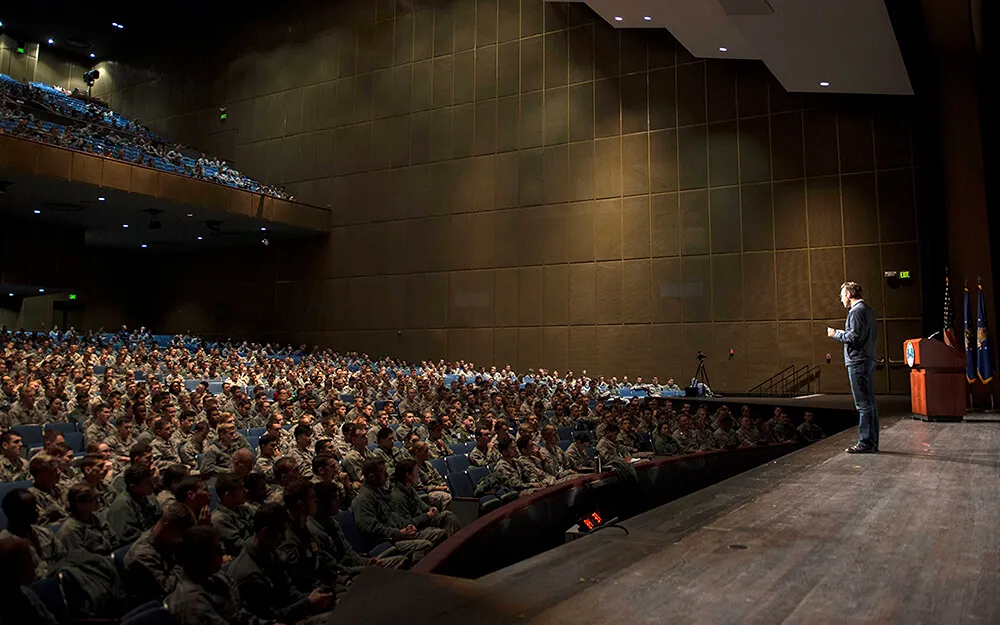
Two weeks later, Simon reported back at Air Mobility Command headquarters to report back to them on what he’d seen and to share any insights he’d gleaned. It was a small auditorium, but it was packed with generals, colonels, and the rest of the brass. He talked about what he’d experienced during the airdrop and shared what had impressed him and what tweaks could be made, but in his mind raged an internal debate: should he tell the story of coming home, of sleeping next to the casket?
He decided to tell the story, and the emotions were raw. As he spoke, he welled up. He couldn’t get the words out. From the back of the room, he heard the voice of a four-star officer. “Go on,” he said.
It was a totally different response from what he would have heard in the private sector. There, a well-meaning listener might say, “It’s okay. Don’t worry,” which has the effect of moving a person aside. “Go on” did something different. In a moment of pain, fear, and overwhelm, nobody told him to stop. Simon heard those words as a promise that he was safe and that the room was with him.
That experience is behind Leaders Eat Last. It showed him the power of community and of a strong culture built on love. He’d spoken to many folks in the military, to the most hardcore warriors, and had asked them what made them good at what they did. And the most common answer he’d receive was “love.” In the private sector, we call each other colleagues or coworkers. But in the military, they call each other brother and sister. That relationship is real, and it’s built on love.
For leaders in any organization, the story invites a simple question. When someone on your team is struggling, what do they hear from you? Simon chose the response he once received. When a friend is struggling, he says, “Go on.”

Nobody teaches you how to lead.
We can.
Learn what great leaders actually do and why it works.
Explore the Leaderful App